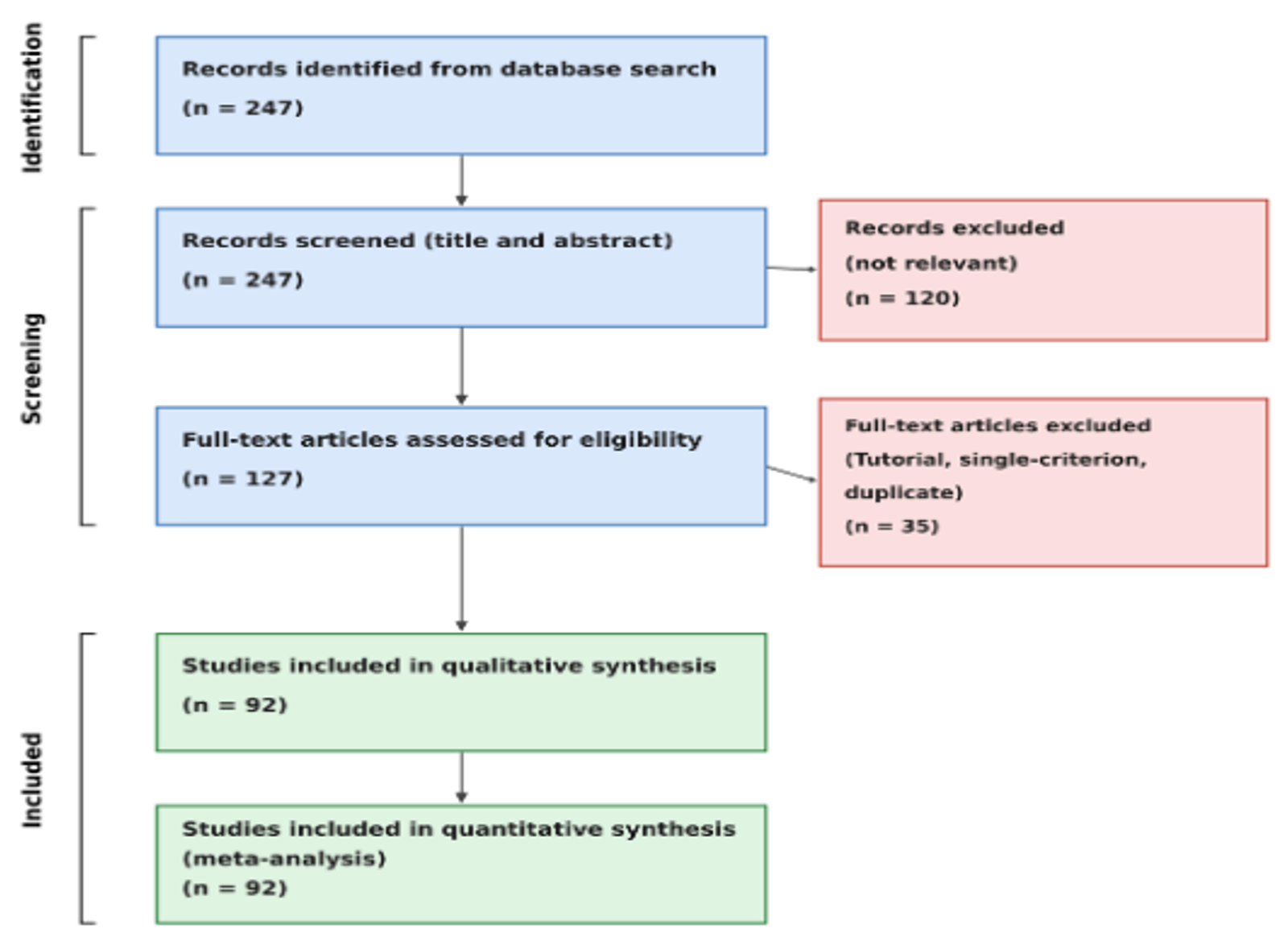
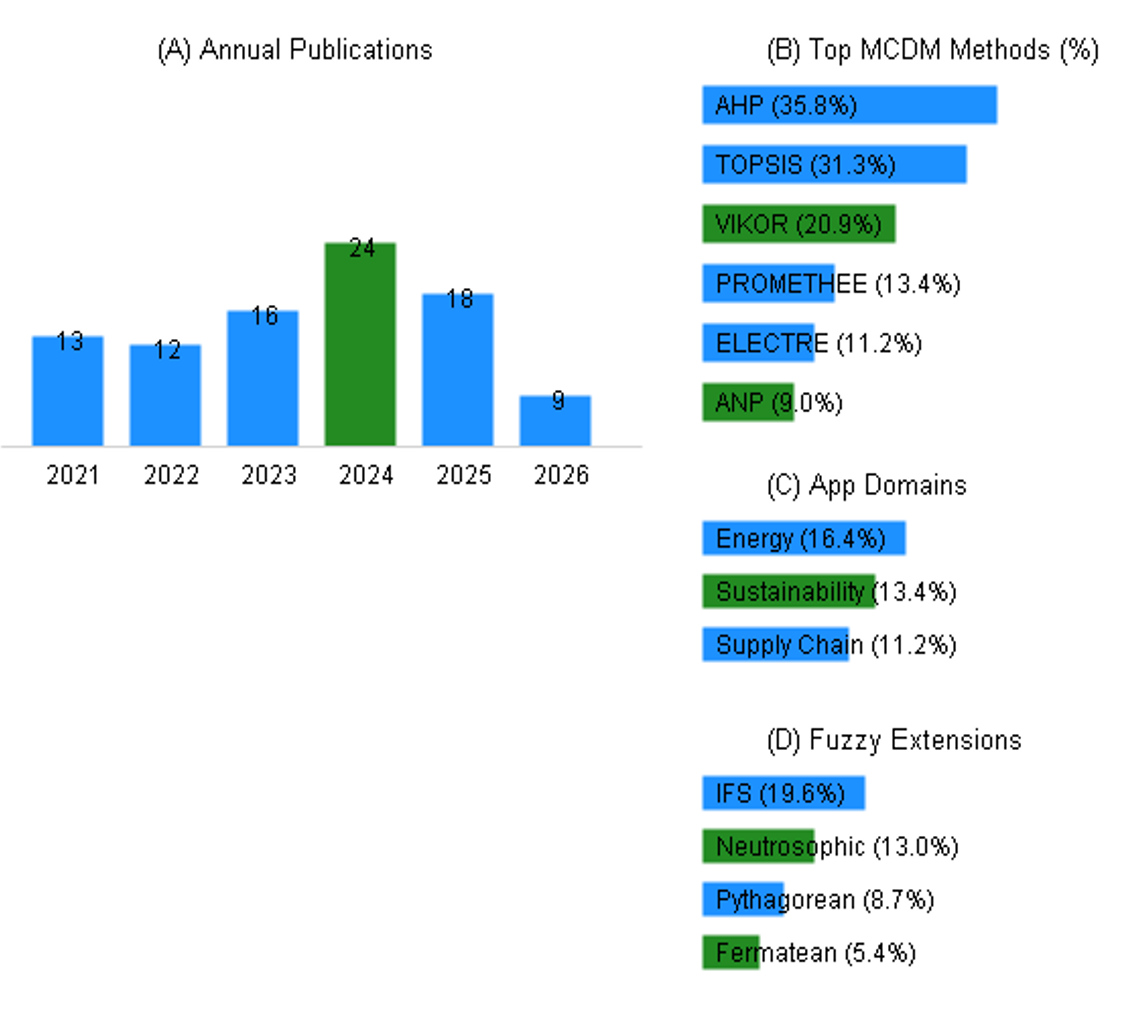
This systematic review of 92 MCDM framework studies (2021–2026) shows a dynamic and very active field with following features:
i. First, methodological clustering around hybrid approaches in which subjective/objective weighting and distance-based, outranking, compromise and utility-based weighting are used.
ii. Sophisticated uncertainty modelling with higher order fuzzy sets (intuitionistic, Pythagorean, Fermatean, picture, spherical, neutrosophic) and other uncertainty modelling frameworks (gray system, rough set, evidential reasoning).
iii. Integration of 3 key forms of AI—machine learning for weight learning, deep reinforcement learning for sequential decisions, and large language models for end-to-end MCDM automation.
iv. Growth in application areas, stimulated by sustainability needs, led by energy, circular economy and green supply chain.
v. Lack of explicit guidance for method selection, dynamic decision-making and group decisions, validation standards and explainability.
i. A principled approach to method selection, based on theoretical analysis and empirical benchmarking to link characteristics of the problem with the suitability of the method.
ii. Standardization of validation procedures, such as benchmark data, test repeatability, and report checklists in MCDM studies.
iii. Dynamic and adaptive MCDM frameworks—where preferences, criteria and alternatives change over time, which are formally modelled and guaranteed in a theoretic sense.
iv. Efficient and transparent group decision making mechanisms that can be scaled up to large and heterogeneous groups of stakeholders with conflict resolution.
v. Explainable AI-MCDM integration ensuring interpretability, trust and ethical alignment in AI-augmented decision support.
vi. Human-AI Collaborative MCDM Paradigms based on the complementary strengths of human judgment and computational analysis.
vii. Reusability of domain-specific MCDM ontologies comprising reusable criteria, methods and validation practices for major application areas
The MCDM field is at a turning point: the fusion of traditional operations research rigor and artificial intelligence scalability. Sustained methodological innovation, built upon the principles of decision theory and proven through rigorous, reproducible practice is needed to realize the potential of this convergence.
1Abdullah, A., & Alshibani, A. (2021). Multi-criteria decision-making framework for selecting sustainable private partners for housing projects. Journal of Financial Management of Property and Construction, 26(3), 367–388. https://doi.org/10.1108/JFMPC-07-2020-0046.
2Adriyendi, A., & Melia, Y. (2021). Multi-attribute decision making using hybrid approach based on benefit-cost model for sustainable fashion. International Journal of Advances in Data and Information Systems. https://doi.org/10.25008/ijadis.v2i1.1200
3Aiello, G., Quaranta, S., Inguanta, R., Certa, A., & Venticinque, M. (2024). A multi-criteria decision-making framework for zero emission vehicle fleet renewal considering lifecycle and scenario uncertainty. Energies, 17(6), Article 1371. https://doi.org/10.3390/en17061371
4Aktaş, N., & Demirel, N. (2021). A hybrid framework for evaluating corporate sustainability using multi-criteria decision making. Environment, Development and Sustainability, 23, 12476–12500. https://doi.org/10.1007/s10668-021-01311-5
5Al-jedai, A., Almudaiheem, H., Alruthia, Y., Althemery, A., Alabdulkarim, H., Ojeil, R., Alrumaih, A., AlGhannam, S., Almutairi, A. R., & Hasnan, Z. (2024). A step toward the development of the first national multi-criteria decision analysis framework to support healthcare decision making in Saudi Arabia. Value in Health Regional Issues. https://doi.org/10.1016/j.vhri.2023.12.005
6Alexe, C.-M., & Nechita, R. (2025). A theoretical framework for multi-attribute decision-making methods in the intelligent leading and allocation of human resources in research and development projects. Sustainability, 17(16), Article 7535. https://doi.org/10.3390/su17167535
7Ayan, B., Abacıoğlu, S., & Basílio, M. P. (2023). A comprehensive review of the novel weighting methods for multi-criteria decision-making. Information, 14(5), Article 285. https://doi.org/10.3390/info14050285
8Bakker-den Hartog, D., Lugten, M., & Ottele, M. (2025). Multi-criteria-decision-making framework using ecosystem-services for an integral design of vertical greenery systems. Urban Forestry & Urban Greening. https://doi.org/10.1016/j.ufug.2025.128931
9Balasbaneh, A. T., Aldrovandi, S., & Sher, W. (2025). A systematic review of implementing multi-criteria decision-making (MCDM) approaches for the circular economy and cost assessment. Sustainability, 17(11), Article 5007. https://doi.org/10.3390/su17115007
10Basílio, M. P., Pereira, V., Costa, H. G., Santos, M., & Ghosh, A. (2022). A systematic review of the applications of multi-criteria decision aid methods (1977–2022). Electronics, 11(11), Article 1720. https://doi.org/10.3390/electronics11111720
11Biswas, S., Pamucar, D., Kar, S., & Sana, S. (2021). A new integrated FUCOM-CODAS framework with Fermatean fuzzy information for multi-criteria group decision-making. Symmetry, 13(12), Article 2430. https://doi.org/10.3390/sym13122430
12Boix-Cots, D., Pardo-Bosch, F., & Pujadas, P. (2023). A systematic review on multi-criteria group decision-making methods based on weights: Analysis and classification scheme. Information Fusion, 97, 101–114. https://doi.org/10.1016/j.inffus.2023.03.004
13Chen, W., Gu, J., Zeng, S., & Xie, X. (2023). Solid waste landfill site assessment framework based on single-valued neutrosophic hybrid aggregation and multi-criteria analysis. Sustainability, 15(7), Article 6021. https://doi.org/10.3390/su15076021
14Cheng, R., Fan, J., & Wu, M. (2023). A dynamic multi-attribute group decision-making method with R-numbers based on MEREC and CoCoSo method. Complex & Intelligent Systems, 9, 3457–3477. https://doi.org/10.1007/s40747-023-01032-4
15Đoković, L. S., & Doljanica, D. (2023). Application of AHP and MABAC methods in the framework of multi-criteria decision-making in the selection of investment projects. Journal of Process Management and New Technologies, 11(1), 45–52. https://doi.org/10.5937/jpmnt11-47800
16Dombi, J., & Jónás, T. (2024). Learning the weights using attribute order information for multi-criteria decision making tasks. OPSEARCH, 61, 1023–1045. https://doi.org/10.1007/s12597-024-00779-9
17Elsayed, A. (2024). Multi-criteria decision-making framework for evaluating green fuels alternatives: A hybrid MEREC-TODIM approach. Neutrosophic Optimization and Intelligent Systems, 3, Article 3323. https://doi.org/10.61356/j.nois.2024.3323
18Gao, J., Guo, F., Ma, Z., & Huang, X. (2021). Multi-criteria decision-making framework for large-scale rooftop photovoltaic project site selection based on intuitionistic fuzzy sets. Applied Soft Computing, 111, Article 107098. https://doi.org/10.1016/j.asoc.2021.107098
19Gebre, S. L., Cattrysse, D., Alemayehu, E., & Van Orshoven, J. (2021). Multi-criteria decision making methods to address rural land allocation problems: A systematic review. International Soil and Water Conservation Research, 9(4), 537–548. https://doi.org/10.1016/j.iswcr.2021.04.005
20[20] Ghosh, S., Mandal, M., & Ray, A. (2021). Green supply chain management framework for supplier selection: An integrated multi-criteria decision-making approach. International Journal of Management Science and Engineering Management, 16(4), 267–278. https://doi.org/10.1080/17509653.2021.1997661
21Govindarajan, V., Shahab, S., Yousef, A. H., Shaikh, Z., Dutta, A., & Anjum, M. (2026). A picture fuzzy multi-criteria decision-making framework for evaluating urban planning proposals under uncertainty. Ain Shams Engineering Journal, 17(4), Article 104098. https://doi.org/10.1016/j.asej.2026.104098
22He, S., Pan, X., Wang, Y.-M., García-Zamora, D., & Martínez-López, L. (2024). A novel multi-criteria decision making framework based on evidential reasoning dealing with missing information from online reviews. Information Fusion, 109, Article 102264. https://doi.org/10.1016/j.inffus.2024.102264
23Huang, H., Burgherr, P., & Macharis, C. (2024). A collaborative group decision-support system: The survey based multi-actor multi-criteria analysis (MAMCA) software. Journal of the Operational Research Society, 75(10), 2031–2047. https://doi.org/10.1080/01605682.2024.2398114
24Işık, Ö., Shabir, M., Demir, G., Puška, A., & Pamucar, D. (2025). A hybrid framework for assessing Pakistani commercial bank performance using multi-criteria decision-making. Financial Innovation, 11, Article 72. https://doi.org/10.1186/s40854-024-00728-x
25Jahani, F., Mohammadi, M. R., Pourdaryaei, A., Shayesteh, E., & Karimi, M. (2022). A novel multi-criteria decision-making framework in electrical utilities based on gray number approach. IEEE Access, 10, 102276–102290. https://doi.org/10.1109/ACCESS.2022.3222766
26Jia, F., Wang, Y., & Su, Y. (2023). GRA-Based dynamic hybrid multi-attribute three-way decision-making for the performance evaluation of elderly-care services. Mathematics, 11(14), Article 3176. https://doi.org/10.3390/math11143176
27Kiratsoudis, S., & Tsiantos, V. (2023). Enhancing personnel selection through the integration of the entropy synergy analysis of multi-attribute decision making model: A novel approach. Information, 15(1), Article 1. https://doi.org/10.3390/info15010001
28Kizielewicz, B., & Sałabun, W. (2024). SITW method: A new approach to re-identifying multi-criteria weights in complex decision analysis. Spectrum of Mechanical Engineering and Operational Research, 11, Article 19. https://doi.org/10.31181/smeor11202419
29Kizielewicz, B., Shekhovtsov, A., Wiȩckowski, J., Wątróbski, J., & Sałabun, W. (2024). Intelligent characteristic objects method (INCOME): A data knowledge-based multi-criteria decision analysis. Artificial Intelligence Review, 57, Article 10892. https://doi.org/10.1007/s10462-024-10892-2
30Li, Y., & Hu, Z. (2021). A review of multi-attributes decision-making models for offshore oil and gas facilities decommissioning. Journal of Ocean Engineering and Science, 6(4), 412–425. https://doi.org/10.1016/j.joes.2021.05.002
31Liu, Y., Yu, C., Guo, F., Zhao, X., Shan, J., Lu, T., Peng, H., & Yuan, D. (2024). Multi-criteria decision-making framework (AHP-TOPSIS): Pavement preventive maintenance case study for ordinary national trunk highways. Buildings, 14(10), Article 3048. https://doi.org/10.3390/buildings14103048
32Lu, C., & Zhang, Y. (2026). A dynamic hybrid weighting framework for teaching effectiveness evaluation in multi-criteria decision-making: Integrating interval-valued intuitionistic fuzzy AHP and entropy triggering. Entropy, 28(2), Article 241. https://doi.org/10.3390/e28020241
33Madanchian, M., & Taherdoost, H. (2023). A comprehensive guide to the TOPSIS method for multi-criteria decision making. Sustainable Social Development, 1(1), Article 2220. https://doi.org/10.54517/ssd.v1i1.2220
34Mahajan, A., Singh, I., & Arora, N. (2023). An integrated multi-criteria decision-making framework for the selection of sustainable biodegradable polymer for food packaging applications. Environment, Development and Sustainability, 25, 13052–13078. https://doi.org/10.1007/s10668-023-03052-z
35Mathaba, T., & Abo-Al-Ez, K. M. (2024). Design of hybrid renewable energy systems: Integrating multi-objective optimization into a multi-criteria decision-making framework. Engineering Reports, 6(2), Article e13074. https://doi.org/10.1002/eng2.13074
36Montella, L., Liu, X., Monaco, R., Murino, T., & Nielsen, P. S. (2025). An integrated multi-criteria decision making framework for industrial excess heat recovery and utilization. Energy, 294, Article 92721. https://doi.org/10.1016/j.energy.2025.92721
37Nematollahi, M., Guitouni, A., Izadyar, N., Belacel, N., & Park, A. (2026). Multi-attribute utility deep reinforcement learning method for sequential multi-criteria decision problems: Application to human resource planning. Computers & Operations Research, 185, Article 107426. https://doi.org/10.1016/j.cor.2026.107426
38Nhu, N. T. T., Hung, K. V., Mai, N. T. H., Shiomi, Y., Nishiuchi, H., Nguyen-Ngoc, D., & Ngoc, A. M. (2026). Multi-criteria decision-making framework for evaluating urban freight transport measures toward sustainable transport system. Innovative Infrastructure Solutions, 11, Article 2391. https://doi.org/10.1007/s41062-025-02391-2
39Novoa-Hernández, P., Pelta, D., & Corona, C. C. (2025). Helping to choose a robust alternative: A sensitivity analysis and a software tool for multi-criteria decision-making. Expert Systems, 42(3), Article e70031. https://doi.org/10.1111/exsy.70031
40Özder, E. H. (2025). A sustainable multi-criteria decision-making framework for online grocery distribution hub location selection. Processes, 13(6), Article 1653. https://doi.org/10.3390/pr13061653
41Page, M. J., McKenzie, J. E., Bossuyt, P. M., Boutron, I., Hoffmann, T. C., Mulrow, C. D., ... & Moher, D. (2021). The PRISMA 2020 statement: An updated guideline for reporting systematic reviews. BMJ, 372, Article n71. https://doi.org/10.1136/bmj.n71
42Pamucar, D., Žižović, M., Biswas, S., & Božanić, D. (2021). A new logarithm methodology of additive weights (LMAW) for multi-criteria decision-making: Application in logistics. Facta Universitatis, Series: Mechanical Engineering, 19(2), 353–372. https://doi.org/10.22190/FUME210214031P
43Radmehr, A., Bozorg-Haddad, O., & Loáiciga, H. (2022). Integrated strategic planning and multi-criteria decision-making framework with its application to agricultural water management. Scientific Reports, 12, Article 12194. https://doi.org/10.1038/s41598-022-12194-5
44Rao, R. V. (2023). BHARAT: A simple and effective multi-criteria decision-making method that does not need fuzzy logic, Part-1: Multi-attribute decision-making applications in the industrial environment. International Journal of Industrial Engineering Computations, 14(2), 187–214. https://doi.org/10.5267/j.ijiec.2023.12.003
45Sahoo, L., & Ghosh, S. (2026). A reinforcement learning-based framework for multi-criteria decision-making. Intelligent Systems Research and Applications Journal, 2, Article ydm6xr12. https://doi.org/10.59543/ydm6xr12
46Sánchez-Martínez, F., Abellan-Perpiñan, J., Martínez-Pérez, J., & Gómez-Torres, J.-L. (2024). Design of a multiple criteria decision analysis framework for prioritizing high-impact health technologies in a regional health service. International Journal of Technology Assessment in Health Care, 40, Article e17. https://doi.org/10.1017/S0266462324000205
47Seddiki, M., & Bennadji, A. (2025). A life cycle carbon assessment and multi-criteria decision-making framework for building renovation within the circular economy context: A case study. Buildings, 15(11), Article 1894. https://doi.org/10.3390/buildings15111894
48Shbool, M. A., Arabeyyat, O., Al-Bazi, A., & Alalaween, W. H. (2021). An integrated multi-criteria decision-making framework for a medical device selection in the healthcare industry. Cogent Engineering, 8(1), Article 1968741. https://doi.org/10.1080/23311916.2021.1968741
49Shi, C., & Yao, Y. (2025). Explainable multi-criteria decision-making: A three-way decision perspective. International Journal of Approximate Reasoning, 179, Article 109528. https://doi.org/10.1016/j.ijar.2025.109528
50Singh, S., Upadhyay, S., & Powar, S. (2022). Developing an integrated social, economic, environmental, and technical analysis model for sustainable development using hybrid multi-criteria decision making methods. Applied Energy, 306, Article 118235. https://doi.org/10.1016/j.apenergy.2021.118235
51Spina, L. D., & Lanteri, C. (2024). A collaborative multi-criteria decision-making framework for the adaptive reuse design of disused railways. Land, 13(6), Article 851. https://doi.org/10.3390/land13060851
52Suwantika, A. A., Purwadi, F. V., Zakiyah, N., Puspitasari, I. M., Abdulah, R., Diantini, A., Boersma, C., & Postma, M. (2021). Multi-criteria decision analysis to prioritize the introduction of new vaccines in Indonesia by using the framework of the strategic multi-attribute ranking tool for vaccines (SMART vaccines). Expert Review of Vaccines, 20(7), 843–856. https://doi.org/10.1080/14760584.2021.1874926
53Taherdoost, H., & Madanchian, M. (2023). Multi-criteria decision making (MCDM) methods and concepts. Encyclopedia, 3(1), Article 6. https://doi.org/10.3390/encyclopedia3010006
54Takemura, K., Tamari, Y., & Ideno, T. (2025). Classifying decision strategies in multi-attribute decision-making: A multi-dimensional scaling and hierarchical cluster analysis of simulation data. Mathematics, 13(17), Article 2778. https://doi.org/10.3390/math13172778
55Tešić, D. (2025). A machine learning and multi-criteria decision-making framework for student grade prediction. Smart Multi-Criteria Analytics and Reasoning Technologies, 1(1), Article 3. https://doi.org/10.65069/smart1120253
56Tomelleri, F., Bosetti, P., & Brunelli, M. (2025). Optimizing 3D printer selection through multi-criteria decision analysis. The International Journal of Advanced Manufacturing Technology, 132, 2457–2474. https://doi.org/10.1007/s00170-025-16148-9
57Wang, H., Zhang, F., & Mu, C. (2025). One for all: A general framework of LLMs-based multi-criteria decision making on human expert level. arXiv preprint arXiv:2502.15778. https://doi.org/10.48550/arXiv.2502.15778
58Wang, J., & Zhang, X. (2022). A novel multi-criteria decision-making method based on rough sets and fuzzy measures. Axioms, 11(6), Article 275. https://doi.org/10.3390/axioms11060275
59Wang, X., Zhang, B., Xu, Z., Li, M., & Škare, M. (2025). A multi-dimensional decision framework based on the XGBoost algorithm and the constrained parametric approach. Scientific Reports, 15, Article 87207. https://doi.org/10.1038/s41598-025-87207-0
60Wei, Q., & Zhou, C. (2022). A multi-criteria decision-making framework for electric vehicle supplier selection of government agencies and public bodies in China. Environmental Science and Pollution Research International, 29, 66986–67005. https://doi.org/10.1007/s11356-022-22783-6
61Wei, Y.-M. (2025). A hybrid multi-criteria decision-making framework for the strategic evaluation of business development models. Information, 16(6), Article 454. https://doi.org/10.3390/info16060454
62Wiȩckowski, J., & Sałabun, W. (2023). Sensitivity analysis approaches in multi-criteria decision analysis: A systematic review. Applied Soft Computing, 145, Article 110915. https://doi.org/10.1016/j.asoc.2023.110915
63Xie, Z., Tian, G., & Tao, Y. (2022). A multi-criteria decision-making framework for sustainable supplier selection in the circular economy and Industry 4.0 era. Sustainability, 14(24), Article 16809. https://doi.org/10.3390/su142416809
64Xu, T., You, X., Yang, M., Shi, Y., & Mao, R. (2024). Data asset quality evaluation framework based on a hybrid multi-criteria decision-making method. Quality and Reliability Engineering International, 40(6), 2693–2710. https://doi.org/10.1002/qre.3692
65Yang, J., Geng, X., & Zhang, Y. (2026). A cloud-based multi-criteria decision-making framework for green-resilient supplier selection of manufacturing industry. PLOS ONE, 21(1), Article e0343165. https://doi.org/10.1371/journal.pone.0343165
66Yu, Y., Wu, S., Yu, J., Xu, Y., Song, L., & Xu, W. (2022). A hybrid multi-criteria decision-making framework for offshore wind turbine selection: A case study in China. Applied Energy, 327, Article 120173. https://doi.org/10.1016/j.apenergy.2022.120173
67Yuan, Z., Wen, B., He, C., Zhou, J. X., Zhou, Z., & Xu, F. (2022). Application of multi-criteria decision-making analysis to rural spatial sustainability evaluation: A systematic review. International Journal of Environmental Research and Public Health, 19(11), Article 6572. https://doi.org/10.3390/ijerph19116572
68Zhang, Q., Fan, J., & Gao, C. (2024). CRITID: Enhancing CRITIC with advanced independence testing for robust multi-criteria decision-making. Scientific Reports, 14, Article 75992. https://doi.org/10.1038/s41598-024-75992-z
69Zhang, Y., Kong, M., Wang, W. Z., Deveci, M., Bilican, M. S., & Delen, D. (2026). A multi-criteria decision-making framework for metaverse adoption: Evidence from higher education systems. Expert Systems with Applications. https://doi.org/10.1016/j.eswa.2025.129132
70Ziemba, P. (2022). Energy security assessment based on a new dynamic multi-criteria decision-making framework. Energies, 15(24), Article 9356. https://doi.org/10.3390/en15249356
71Zolghadr-Asli, B., Bozorg-Haddad, O., Enayati, M., & Chu, X. (2021). A review of 20-year applications of multi-attribute decision-making in environmental and water resources planning and management. Environment, Development and Sustainability, 23, 12476–12500. https://doi.org/10.1007/s10668-021-01278-3